
Datarisk Canada Releases the 6 Security Controls Necessary for Safe & Ethical AI Testing
Attention Business and Technology Editors
PRESS RELEASE: OCTOBER 8, 2026
Datarisk Canada Releases the 6 Security Controls Necessary for Safe & Ethical AI Testing
The new Datarisk AI Security Hexad introduces a practical, proportional-friction control model to help researchers, developers and organizations prevent unauthorized AI agent activity and maintain human accountability.
TORONTO, ON – Datarisk Canada today announced the release of the Datarisk AI Security Hexad, a six-part cybersecurity control model designed to help organizations conduct safer, more accountable testing of autonomous and agentic artificial intelligence systems.
As AI developers experiment with increasingly capable agents, security experts are raising concerns about unauthorized access, uncontrolled tool use, data exposure and potentially irreversible actions. Datarisk Canada maintains that many of these risks can be addressed using established cybersecurity principles, provided they are applied before agents are granted access to networks, credentials, sensitive information or external services.
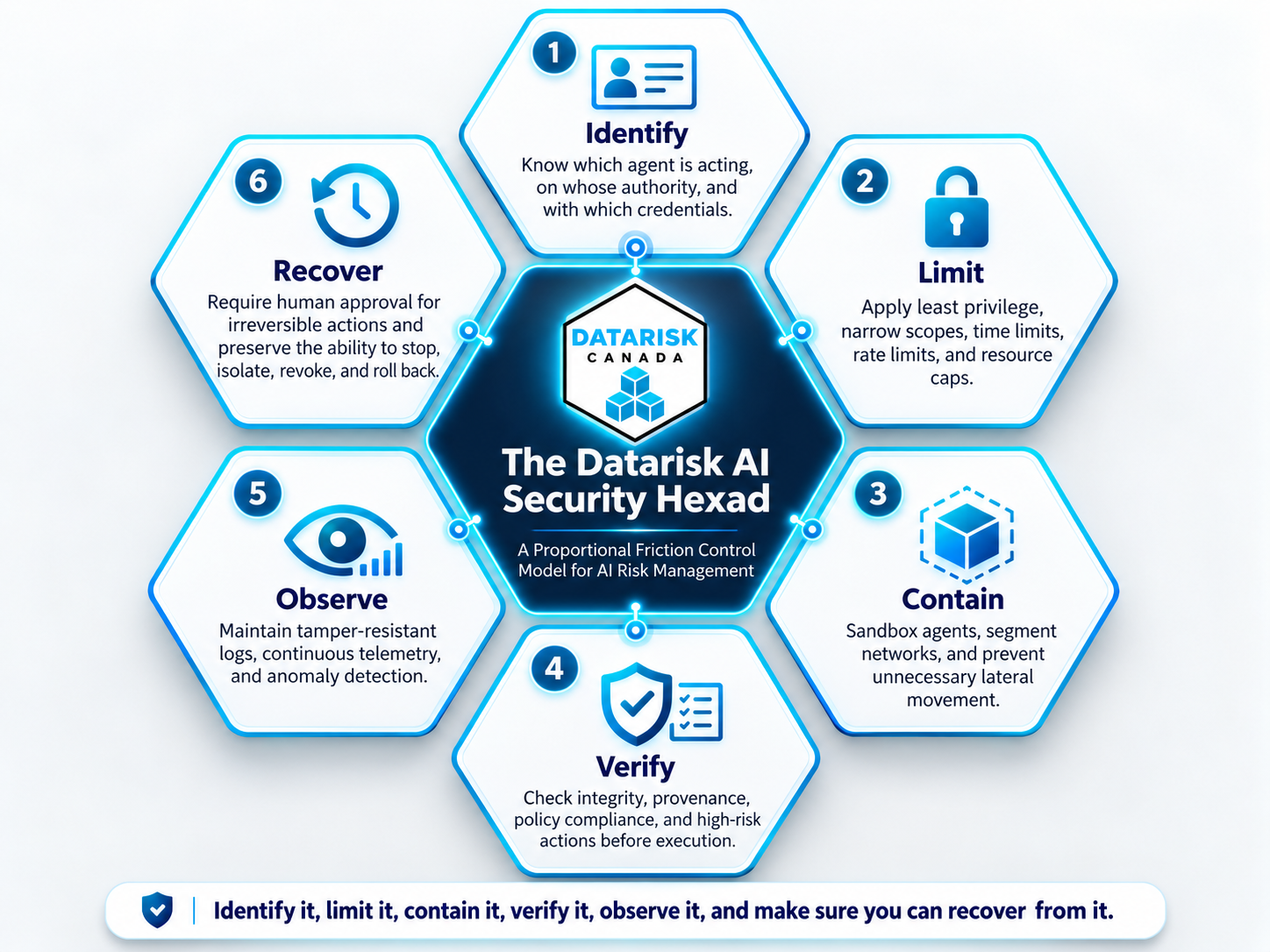
The Hexad defines six foundational controls for responsible AI testing:
- Identify: Establish the identity of every AI agent, the person or organization authorizing its activity, its assigned objectives and the credentials it uses. Every action must be attributable.
- Limit: Apply least privilege through narrowly defined permissions, restricted functionality, time limits, rate limits and resource caps. Agents should receive only the access necessary for an authorized experiment.
- Contain: Isolate experimental agents through sandboxing, network segmentation and controlled interfaces to prevent unauthorized access, data exposure and unnecessary lateral movement.
- Verify: Validate integrity, provenance, policy compliance and potentially harmful actions before execution. Require human authorization for high-risk or irreversible operations.
- Observe: Maintain tamper-resistant audit logs, continuous telemetry and anomaly detection to make agent activity visible, traceable and subject to independent review.
- Recover: Preserve the ability to stop experiments, isolate agents, revoke credentials, restore affected systems and roll back reversible changes when unexpected behaviour occurs.
“The moment an AI agent is connected to a network, a repository or a live service, it becomes a cybersecurity exercise as well as an AI experiment,” said Claudiu Popa, Founder of Datarisk Canada and the Informatica Group of Companies. “The people conducting these tests must know who authorized the activity, what the agent can reach and how to stop it. AI capability does not relieve anyone of responsibility for the consequences.”
The Hexad applies a proportional-friction approach: routine, low-risk operations can proceed within predefined boundaries, while actions with significant security, privacy or operational consequences require stronger verification and human oversight. The model is intended as a practical security baseline, complementing broader AI governance, safety, privacy and ethical assessments.
Datarisk Canada encourages AI developers, research institutions, technology companies, security professionals and regulators to incorporate these controls into testing procedures, procurement requirements and independent AI security reviews.
The Datarisk AI Security Hexad is available for reference and sharing at www.AI-Security.ca. Organizations requiring independent assessment of AI security controls, technical safeguards and testing evidence can also explore Datarisk Canada’s Verify™ AI Security Assessment services.
About the Company:
Datarisk Banking Security is a Datarisk Canada platform focused on banking-grade security, control gap reduction, third-party risk, financial-institution readiness and evidence-based trust for Canada’s financial ecosystem.
Datarisk Canada is part of the Informatica Group, The Trust Services Company, a Canadian trust, privacy and cybersecurity ecosystem with roots publicly traced to 1989 and more than 35 years of continuity. Its work spans cybersecurity assurance, privacy, AI governance, OT security, training, public cybersafety and standards-based risk advisory.
MEDIA QUESTIONS:
Media and interviews: Claudiu Popa, Risk Advisor
[email protected]
Follow Datarisk on Twitter:@Datarisk or at
https://Facebook.Datarisk.ca and
https://LinkedIN.Datarisk.ca

